
On this page
- What Is Idempotency?
- A simple real-world example
- How Does Idempotency Work?
- Idempotency versus identical responses
- Why Is Idempotency Important in APIs?
- 1. Network timeouts
- 2. Duplicate payments
- 3. Duplicate orders and bookings
- 4. Distributed system reliability
- Which HTTP Methods Are Idempotent?
- Is POST an idempotent HTTP method?
- What Is an Idempotency Key?
- How an idempotency key prevents duplicate requests
- What if the same key is used with different data?
- How long should an idempotency key be stored?
- How to Implement Idempotency in a REST API
- Step 1: Generate a stable key for each logical operation
- Step 2: Validate the request
- Step 3: Reserve the key atomically
- Step 4: Track the operation’s state
- Step 5: Perform the operation and persist its result
- Step 6: Return the appropriate result on retries
- Idempotency in Payment Processing and Microservices
- Webhooks and message consumers
- Does idempotency guarantee exactly-once processing?
- Idempotency vs. Caching vs. Deduplication
- How to Test API Idempotency
- What should developers verify?
- Common Idempotency Implementation Mistakes
- Generating a new key for every retry
- Checking for duplicates without atomic coordination
- Storing keys only in memory
- Treating every error as safe to retry
- Ignoring downstream side effects
- Reusing a key for a different operation
- Assuming a key prevents every duplicate forever
- Frequently Asked Questions
- What is idempotency in programming?
- What is an example of idempotency?
- Why is idempotency important in APIs?
- What is an idempotency key?
- Which HTTP methods are idempotent?
- Is POST an idempotent method?
- How does idempotency prevent duplicate payments?
- What is the difference between idempotency and caching?
- How do you implement idempotency in a REST API?
- Does idempotency mean code runs only once?
- Final Takeaway
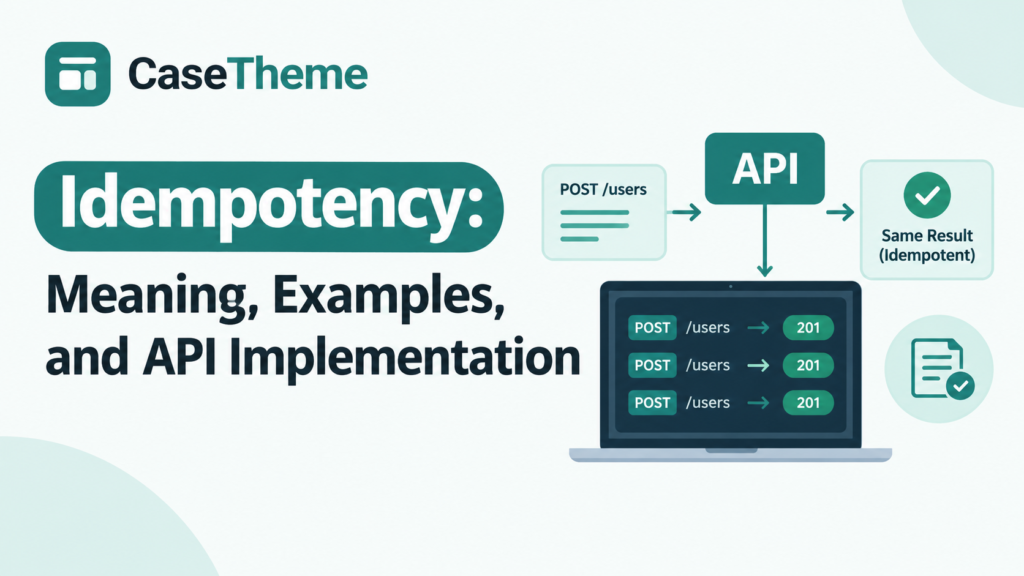
Idempotency is a property that allows an operation to be repeated without changing its intended effect after the first successful execution. In API development, it helps systems handle retries safely when a request times out, a connection drops, or a client never receives the original response.
For example, if an API updates a customer’s preferred language to English, repeating that update should leave the language set to English. By contrast, an operation that adds $10 to an account balance each time it runs would produce a different result with every repetition.
Idempotency is especially useful in REST APIs, payment processing, distributed systems, and event-driven applications. Developers can implement it through naturally idempotent operations or mechanisms such as idempotency keys, durable request records, and database constraints.
What Is Idempotency?
Idempotency means that applying the same operation repeatedly has the same intended effect as applying it once.
In HTTP, this definition concerns the effect requested by the client, not necessarily the response body, status code, or every internal activity performed by the server. The HTTP specification identifies safe methods, PUT, and DELETE as idempotent methods. See RFC 9110, Section 9.2.2.
Consider an application that lets users update their notification preferences.
A request sets the preference to email. Whether the application receives that request once or five times, the stored preference remains email.
Now consider a different operation that increments a counter. Sending the same increment request five times increases the counter five times. That operation is not idempotent by itself.
The distinction matters because modern applications frequently retry operations after communication failures. A client may not know whether the server processed the first request before the connection failed.
A simple real-world example
Imagine ordering a product online.
- You click the Place Order button.
- The server creates your order.
- The response fails to reach your browser.
- You click the button again.
Without duplicate protection, the application might create two orders. With an appropriate idempotency mechanism, the second request can be recognized as a retry of the same logical operation.
The goal is not to prevent every repeated HTTP request. The goal is to prevent unintended duplicate effects.
How Does Idempotency Work?
An idempotent operation is designed so that repeating the same logical action does not accumulate additional effects.
For example, compare these operations:
| Operation | Repeated effect | Idempotent? |
|---|---|---|
| Set account status to active | Status remains active | Yes |
| Replace a profile with the same data | Profile remains in the same intended state | Yes |
| Delete a specific resource | Resource remains deleted | Yes |
| Add a new order for every request | Additional orders may be created | No |
| Increase a balance by $10 | Balance increases again | No |
| Send a new email for every request | Additional emails may be sent | No |
These examples describe the intended application behavior. Real implementations must preserve that behavior in their database updates, external calls, and other side effects.
Idempotency versus identical responses
An important distinction is that idempotency does not require every response to be identical.
For example, a DELETE request might return 200 OK when it deletes a resource and 404 Not Found when the resource is already absent. The responses differ, but the intended final state remains the same.
Similarly, an idempotent GET request can return different data if the underlying resource changes between requests. GET remains idempotent because the client is requesting a read rather than a state-changing operation.
Why Is Idempotency Important in APIs?
APIs communicate over networks, and network communication can fail at inconvenient times.
A client might send a request successfully while losing the connection before receiving the response. The server may have completed the operation, but the client cannot tell from the timeout alone.
Retrying can improve reliability, but repeating a non-idempotent operation may cause duplicate side effects.
Idempotency helps address several common problems.
1. Network timeouts
A timeout does not necessarily mean that the server failed to process a request. It means the client did not receive a response within the expected period.
If the operation is idempotent, the client can generally retry it without changing the intended result.
2. Duplicate payments
Payment requests need particular care. A customer might submit a payment, experience a timeout, and try again because the interface appears unresponsive.
An idempotency mechanism can help the application recognize the second attempt as the same payment operation instead of initiating another charge.
The guarantee depends on the payment provider and the application’s implementation. It does not automatically cover every downstream action.
3. Duplicate orders and bookings
E-commerce systems, reservation platforms, and subscription services may receive repeated requests because users double-click buttons, mobile connections reconnect, or clients retry after failures.
A stable operation identifier and durable server-side processing can prevent the same logical order from being created more than once.
4. Distributed system reliability
In distributed systems, services often communicate through queues, webhooks, and remote APIs. A message may be delivered again when an acknowledgement is lost or a consumer restarts.
Idempotent processing helps a service handle redelivery without applying the same business change repeatedly.
Which HTTP Methods Are Idempotent?
HTTP method semantics provide a useful starting point for API design. According to RFC 9110, all safe methods are idempotent, as are PUT and DELETE.
| HTTP method | Idempotent by definition? | Typical use |
|---|---|---|
| GET | Yes | Retrieve a resource |
| HEAD | Yes | Retrieve response metadata |
| OPTIONS | Yes | Discover communication options |
| TRACE | Yes | Diagnostic request tracing |
| PUT | Yes | Create or replace a resource at a known URI |
| DELETE | Yes | Delete a specified resource |
| POST | Not guaranteed | Create a resource or trigger an operation |
| PATCH | Not guaranteed | Partially modify a resource |
The method’s intended semantics matter more than its name. An application can still implement an endpoint incorrectly.
Is POST an idempotent HTTP method?
POST is not guaranteed to be idempotent by HTTP semantics. Repeating a POST request can create additional resources or trigger the same action multiple times.
However, an application can implement idempotency for a POST endpoint by accepting a stable idempotency key and recording the result associated with that key.
For example, a payment endpoint might accept a request such as:
POST /api/payments
Idempotency-Key: 8e03978e-40d5-43e8-bc93-6894a57f9324
Content-Type: application/json

{
  "order_id": "order_1042",
  "amount": 49.99,
  "currency": "USD"
}
The key identifies the logical payment operation. If the client retries the same operation, it must reuse the same key rather than generate a new one.
The server must still implement the key-handling and persistence logic correctly. Merely adding a header does not make an endpoint idempotent.
What Is an Idempotency Key?
An idempotency key is a unique identifier that allows an API to recognize repeated attempts at the same logical operation.
The client creates the key and includes it in the request. The server stores enough information to determine whether that operation has already been accepted, completed, or is still being processed.
A key might be a randomly generated UUID. Its exact format depends on the API contract.
A typical idempotency record contains:
- The key and its scope, such as the authenticated account and endpoint.
- A fingerprint of the relevant request parameters.
- The operation’s processing status.
- The resulting resource identifier or stored response.
- Timestamps and retention information.
The record should be stored durably when the operation requires protection across server restarts.
How an idempotency key prevents duplicate requests
Consider a payment API receiving the same key twice.
First request: The server validates the request, reserves the key, and begins processing the payment.
Second request: The server finds the existing key and does not independently start the same payment operation.
After completion: A retry can receive the stored result or the appropriate response defined by the API contract.
This is different from simply checking whether a payment exists and then creating one. A non-atomic check followed by an insert can allow two concurrent requests to pass the check before either creates its record.
What if the same key is used with different data?
A server should not silently treat different operations as identical just because they share a key.
For example, using the same key for a $49.99 payment and a $99.99 payment creates an ambiguity. The server should detect that the request parameters differ and reject the conflicting reuse according to its documented policy.
The key must identify one logical operation, not a general-purpose session or an entire user account.
How long should an idempotency key be stored?
There is no universal retention period for every API. The appropriate period depends on the operation’s risk, expected retry window, data-retention requirements, and the provider’s documented behavior.
For example, Stripe documents that its idempotency keys can be pruned after they are at least 24 hours old. Reusing a key after it has been removed may be treated as a new request. See Stripe’s idempotent request documentation.
Do not assume that every provider uses the same retention period. If an operation can be retried after the key expires, additional business-level duplicate protection may be necessary.
How to Implement Idempotency in a REST API
A reliable implementation requires more than generating a unique identifier. The server must coordinate concurrent requests, store operation results, and recover safely from failures.
The following design is a general pattern. It is not a complete drop-in implementation for a particular programming language or payment provider.
Step 1: Generate a stable key for each logical operation
The client creates a unique key when the user initiates a new operation.
If the request times out and the client retries that same operation, it reuses the original key.
A new, intentional operation should receive a new key. For example, a customer placing a second, separate order should not reuse the first order’s key.
Step 2: Validate the request
Authenticate the caller and validate the request body before performing the business operation.
Determine which parameters define the operation. Depending on the API, those might include the amount, currency, order identifier, and account context.
The API should define what happens when the same key is presented with different parameters.
Step 3: Reserve the key atomically
The server attempts to create a durable record for the key and its operation scope.
A database uniqueness constraint can prevent multiple requests from independently reserving the same scoped key. The reservation and the associated business-state changes should be coordinated through appropriate transactions or concurrency controls.
Avoid relying on this pattern alone:
- Check whether a key exists.
- If it does not, perform the operation.
- Save the key afterward.
Two concurrent requests can both observe that the key is absent and proceed at the same time.
Step 4: Track the operation’s state
A useful record may distinguish between states such as:
IN_PROGRESS: The operation has been reserved and processing has begun.COMPLETED: The outcome has been persisted.FAILED: A failure has been recorded, with retry behavior defined by the API contract.
The exact state model depends on the system. Some errors should be retryable; others should be stored and returned consistently. A generic FAILED state alone does not tell the server whether repeating the operation is safe.
If a second request arrives while the first is still in progress, the server can wait, return an in-progress response, or apply another documented policy. It must not start a second independent execution simply because the first has not finished.
Step 5: Perform the operation and persist its result
Where the business change and idempotency record live in the same database, a transaction can coordinate them.
For example, creating an order and recording the completed idempotency result may be committed together. If the transaction rolls back, neither change should be left partially committed.
External services introduce a harder problem. A local database transaction cannot automatically roll back a payment that another service has already processed.
For those workflows, use the downstream provider’s idempotency mechanism where available, persist the workflow state, and design recovery around uncertain outcomes.
Step 6: Return the appropriate result on retries
When a completed operation is requested again with the same key and matching parameters, return the original result or the documented equivalent.
If the operation is still running, follow the API’s in-progress policy. If the key conflicts with different parameters, reject the request.
The response contract should make these cases understandable to clients so that they do not generate new keys unnecessarily.
Idempotency in Payment Processing and Microservices
Payment systems demonstrate why idempotency needs careful boundaries.
Suppose an application records an order locally and then asks an external payment provider to charge the customer. The provider processes the charge, but the response is lost before the application receives it.
The application now has an uncertain outcome. Blindly sending a new payment request with a new key could create a second charge.
A safer approach is to preserve the original logical operation identifier, retry according to the provider’s documented behavior, and reconcile the result before initiating a distinct payment.
The same principle applies to other distributed workflows.
Webhooks and message consumers
A webhook provider may deliver an event more than once. A queue may also redeliver a message if acknowledgement fails.
A consumer can maintain a durable record of processed event identifiers and coordinate that record with its business-state update. If the same event arrives again, the consumer can recognize it and avoid repeating the effect.
The identifier must represent the event or logical operation correctly. Two distinct events should not be collapsed just because their payloads happen to look similar.
Does idempotency guarantee exactly-once processing?
No. Idempotency and exactly-once processing are related but different concepts.
Idempotency makes repeated execution safe with respect to a defined effect. Exactly-once claims concern how many times processing occurs within a specified system or boundary.
A service may receive the same message more than once but apply its business change only once. That is useful idempotent behavior even though the message was delivered multiple times.
Across independent services, databases, queues, and external payment providers, end-to-end exactly-once guarantees require much more than an idempotency key. Systems generally need explicit coordination, durable state, and recovery procedures.
Idempotency vs. Caching vs. Deduplication
These concepts can work together, but they solve different problems.
| Concept | What it does | What it does not guarantee by itself |
|---|---|---|
| Idempotency | Makes repeated logical operations have the same intended effect | That the code executes only once |
| Caching | Reuses stored data or responses | That a repeated payment or order cannot occur |
| Deduplication | Identifies and suppresses duplicate requests or events | That all side effects are coordinated atomically |
| Exactly-once processing | Describes a processing guarantee within a defined boundary | Automatic exactly-once effects across every external system |
Caching a response may reduce repeated computation, but it does not automatically prevent duplicate database writes or external transactions. Likewise, deduplication can be one mechanism used to implement idempotency, but the underlying business operation must still be handled safely.
How to Test API Idempotency
Testing should cover repeated requests as well as failures and concurrent execution.
Use a test environment and controlled test data. For payment examples, use the provider’s test environment rather than real transactions.
| Test case | Expected behavior |
|---|---|
| Send the same key and payload twice | One logical business operation |
| Retry after a simulated timeout | No duplicate side effect |
| Send the same key with different parameters | Reject conflicting reuse according to the contract |
| Send two matching requests concurrently | At most one logical operation is initiated |
| Restart the service during processing | Recover without creating an unintended duplicate |
| Retry a completed operation | Return the stored or contractually equivalent result |
| Retry a failed operation | Follow the defined error and recovery policy |
| Reuse a key after expiration | Follow the documented retention behavior |
| Deliver the same webhook twice | Apply the event’s business effect once |
| Simulate a downstream timeout | Reconcile the uncertain result before starting a new logical operation |
What should developers verify?
Check both the API response and the underlying business state.
Two requests returning HTTP 200 does not prove that idempotency works. The application might still have created two orders or executed two charges.
Useful assertions include:
- The number of business records created.
- The number of external operations initiated.
- The final account or order state.
- The contents of the idempotency record.
- The behavior of concurrent requests.
- The recovery behavior after a process or network failure.
Common Idempotency Implementation Mistakes
Generating a new key for every retry
A new key can make a retry look like a new operation. Keep the original key for retries of the same logical action.
Checking for duplicates without atomic coordination
A separate existence check followed by an insert is vulnerable to race conditions. Use a durable uniqueness constraint or another appropriate atomic reservation mechanism.
Storing keys only in memory
In-memory records can disappear during a restart or remain inconsistent across multiple server instances. Use durable shared storage when the operation requires protection across those failure conditions.
Treating every error as safe to retry
Some errors occur before processing begins; others occur after a side effect may have happened. The recovery strategy should distinguish them and follow the API’s contract.
Ignoring downstream side effects
A database record cannot by itself guarantee that an external payment, email, or other remote action happened only once. Coordinate the workflow and use downstream idempotency support where available.
Reusing a key for a different operation
Keys must have a defined scope and request identity. Reusing one with different parameters should be detected rather than silently accepted.
Assuming a key prevents every duplicate forever
Retention periods and system boundaries matter. Expired records, independent services, and uncoordinated external actions can still create risks.
Frequently Asked Questions
What is idempotency in programming?
Idempotency is a property of an operation whose repeated execution has the same intended effect as one execution. It is useful for state updates, API retries, payment processing, and other workflows where duplicate side effects would be harmful.
What is an example of idempotency?
Setting a user’s notification preference to email is idempotent because repeating the same update leaves the preference set to email. Incrementing a counter is not idempotent because each repetition increases the value again.
Why is idempotency important in APIs?
It allows clients to retry operations after timeouts or connection failures without unintentionally repeating business effects. It is especially useful when a server may have processed a request even though the client never received its response.
What is an idempotency key?
An idempotency key is a unique identifier for a logical API operation. The server uses it to recognize retries, associate requests with a stored result, and prevent the same operation from being independently executed again.
Which HTTP methods are idempotent?
Under HTTP semantics, GET, HEAD, OPTIONS, TRACE, PUT, and DELETE are idempotent. POST and PATCH are not guaranteed to be idempotent. The actual endpoint must still implement its defined semantics correctly.
Is POST an idempotent method?
POST is not inherently idempotent under HTTP semantics. However, a POST endpoint can implement application-level idempotency through a stable key, durable request tracking, and appropriate concurrency controls.
How does idempotency prevent duplicate payments?
A payment request can carry a stable key identifying the logical transaction. If the request is retried, the payment service recognizes the key and applies its documented retry behavior rather than independently creating another payment. The protection depends on the provider’s contract and the integration’s design.
What is the difference between idempotency and caching?
Idempotency concerns the intended effect of repeated operations. Caching concerns storing and reusing data or responses. A cache does not automatically stop duplicate side effects.
How do you implement idempotency in a REST API?
Use a stable operation key, validate request parameters, reserve the key atomically, persist the processing state and result, handle concurrent requests, and return the appropriate stored result for matching retries. Add recovery logic for failures and external side effects.
Does idempotency mean code runs only once?
No. A request may be received or processed multiple times while the application ensures that the intended business effect occurs only once. Idempotency concerns the effect, not necessarily the number of executions.
Final Takeaway
Idempotency is a core technique for building reliable APIs and distributed applications. It allows systems to tolerate repeated requests without unintentionally repeating their intended business effects.
For developers, the most important principles are to understand HTTP method semantics, use stable idempotency keys for operations that need them, coordinate concurrent requests atomically, persist results durably, and test failure recovery explicitly.
An idempotency key is not a complete reliability strategy on its own. The implementation must account for database transactions, downstream services, key retention, and uncertain outcomes. When those boundaries are designed carefully, retries become much safer and applications become more resilient to ordinary network and processing failures.